
We Must Unstone Ourselves
An Interview with Dancer, Choreographer, and Performer Leja Jurišić
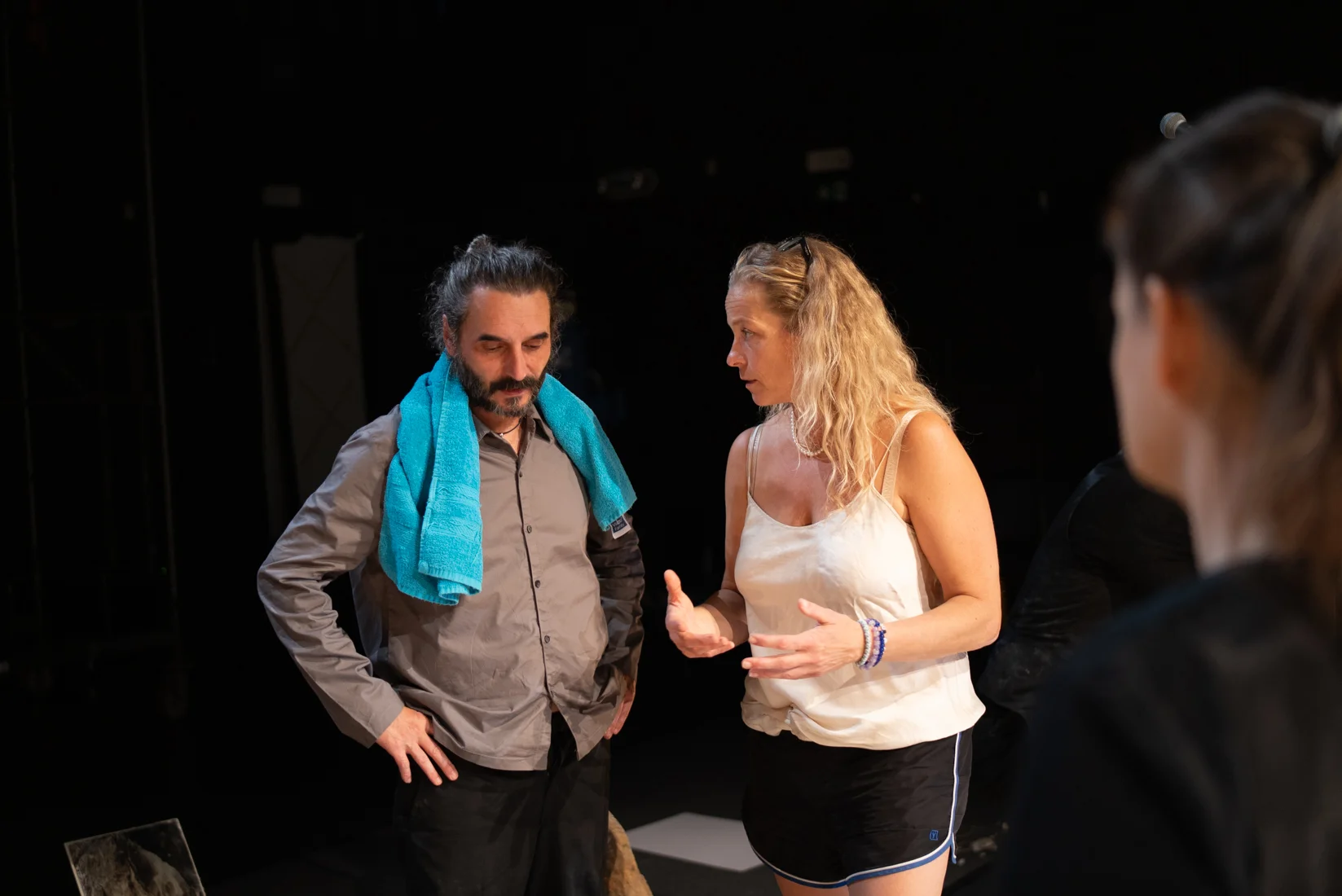
In the course of developing the hybrid performance Dance in Stone, its conceptual leader, director, and choreographer Leja Jurišić reached out to me with a request to form some questions as an individual with a deep affinity towards stone. I willingly accepted, and the result is this interview: a nuanced, complex insight into the artist's realm of exploration, which transcends the stage, delving into the space that exists between man and stone, between movement and contemplation, and between the fleeting and the everlasting.
Let's start at the beginning. Why stone? Why now and why not before?
Stone right at the outset, a wonderful start. Thank you for the question.
In 2016, I began working on a trilogy of duets with male artists, having spent the previous decade working very intensively with mostly women. This resulted in highly progressive projects, with a distinctly feminist orientation. Nevertheless, because validating ideas, perspectives, and beliefs within a group of like-minded individuals can swiftly result in intellectual stagnation, I sought to test my conclusions regarding self-evident hierarchies, gender inequality, and similar issues through direct engagement with the opposite sex.
This led to two duets: Together with actor Marko Mandić, and De facto (Go With Yourself) with musician Milko Lazar. The third male artist, whose name also starts with an M, was the poet Miklavž Komelj. The performance entitled You Can't Wait in Vain began to take shape in the studio just as the COVID-19 pandemic struck, prompting Komelj and me to collaborate remotely. The stones found their way into the project through Komelj's writings and artwork. Wanting to complete the trilogy with a duet despite the absence of physical interaction, I decided that stones would be my co-stars.
This seemed fitting to me, since conversing with the opposite sex sometimes feels akin to speaking with a stone, if I may express this notion in a manner that is both a joke and yet also holds some truth. In a sense, the distance between two people, utter misunderstanding, and profound otherness are inherent in any relationship. Ultimately, the choice to perform a duet with stone proved to be the best possible decision, given that the public was prohibited from going to the theatre at the time of the premiere.
As a result, only my co-star's companions, namely other stones, were able to attend the performance. The audience consisted entirely of stones, while the stage featured one woman, one stone, and several stones in supporting roles. This arrangement offered the best possible conceptual solution and the performance took place in front of the most intimate audience an artist could envision. The process by which the stones arrived at the theatre was as follows: an individual purchased a ticket, brought a stone to the venue, and retrieved it post-performance along with the playbill.
I also believe that stone serves as an appropriate object for collaboration with puppeteers at the Ljubljana Puppet Theatre. Not only is it stationary and lifeless, but it is also rather heavy. As this was my first experience working with puppets, I felt it would be prudent to challenge both myself and the team with a demanding task: introducing a new object. And as it turned out, it was also their first time working with stone. Furthermore, Miklavž Komelj states: “We have entered an age where it seems that everyone has fallen silent about what is essential, even when they speak, and suddenly the very stones must cry out.”
How would you articulate the distinction between stone as a metaphor and stone as a tangible material on stage?
In Western civilization, stone as a metaphor typically represents an obstacle, a burden, coldness, and weight—essentially, nothing positive. It is something we wish to discard, something that must be removed. At the same time, people often collect stones from the sea and from places all over the world—driven by an evidently profound fascination.
Because they are beautiful, we say. I believe they represent far more than mere beauty. In the words of Kant: “A flower is beautiful, a stone is sublime.” Nevertheless, as a society we exploit stones, which Marko Pogačnik refers to as the skeleton of the earth, using them in architecture and infrastructure. Moreover, nearly all the technology we employ is derived from mining activities. Humanity is currently entirely reliant on the extraction of metal ores from stone, and this dependency is likely to persist for a long time.
This is why I am interested in looking at stone from an alternative viewpoint. How might we cultivate a relationship with it that is not based on dominance? In the performance, I prohibit any form of breaking or drilling of the stone. Occasionally, a stone may split in two; however, I do not permit the creation of a stone puppet that would require drilling in order to assemble it. Instead, we have discovered alternative ways of transforming stone into puppets.
In fact, stone is more suited to conveying ideas than to being hammered—unlike humans, who struggle both with conveying ideas and withstanding the force of a hammer. Stone is also remarkably pleasant to the touch, providing a cooling sensation to a heated body. Nevertheless, stone is a highly demanding material. It is certainly not pleasant if it falls on someone's foot, as even a small stone can be surprisingly heavy. Moreover, it tends to bounce in unpredictable ways. It is far bouncier than we realize, which is why it is essential to ensure that no cast members are nearby when it hits the ground. We therefore deliberately refrain from throwing stones onto the ground during the performance. If this happens accidentally, it truly pains me.
The project does not explicitly confront the paradigm that has influenced human behaviour since the Neolithic era (more mining = more metals = more technology + more raw materials = more growth), yet it certainly alludes to it. For a long time, I have been intrigued by the concepts of development and growth.
When I observe the evolution of human society, I notice, for example, that products items which deteriorate within 14 days are increasingly being sold, even though they are far from cheap. It is difficult to categorize such items as products at all. They are essentially worthless—in other words garbage. If a store sells such items, then we should at least refer to it by its proper name: “Garbage shop, welcome!” That might at least make some people laugh.
When our stone co-stars are done with all the repeat performances, they will return to nature. They also spent their summer holidays outdoors.
By observing nature, we can interpret stones as a representation of nature's unyielding power, its strength, which we know will endure even when its most dangerous parasite, humanity, will no longer be here. In the realm of symbolism, however, a stone can also be perceived as embodying coldness and insensitivity (having a heart of stone). What are your thoughts on this duality of meaning that we can derive from stones?
I do not view humans in a negative light. If we refer to them as parasites, this is clearly their role within the Earth's life cycle. The Earth existed prior to humanity and will continue to exist after it. As mentioned earlier, stone serves as its skeleton, meaning that it provides the foundation and support for all other elements. Without stone, the Puppet Theatre would have no base on which to stand. I, too, would have no place to stand on.
The notion of insensitivity is quite intriguing. Can we say that stone is insensitive? We cannot know. What about humanity—is it insensitive? We know that, fundamentally, it is not.
Senses and emotions remain essential guides for human beings, even though we increasingly rely on various other factors. Advertisements tell us what we lack, smart watches tell us how we are feeling, whether we are tired, and—almost like parents—they alert us when we have not taken sufficient steps. We take both natural and artificial medications to alleviate the symptoms we experience. Excessive rationalization can render us insensitive or, at the very least, indifferent. At times, it seems that there is more coldness among people than in stone. As the Bosnian poet Dizdar wrote, we must unstone ourselves.
At times, it seems that there is
more coldness among people than in stone.
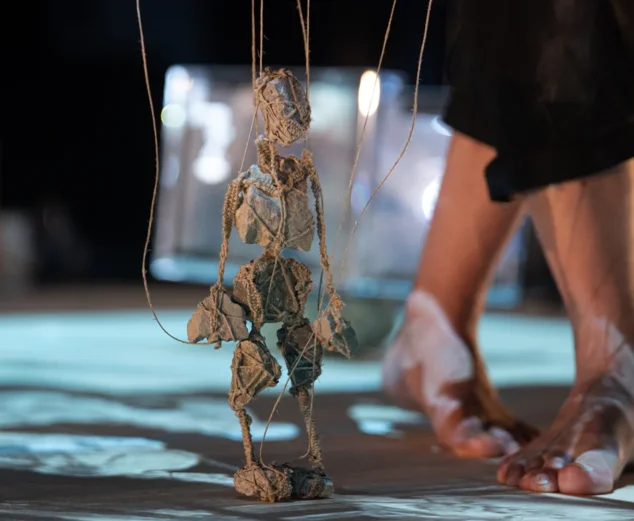
How could art help people to “unstone” themselves, as Dizdar suggests?
I am not sure that art is here to help. If we were to personify it, I think it likes to confront, encourage, and challenge—it also relishes being an intense companion. I do not believe it wants to help by taking us by the hand, as one might hold a child's hand. Perhaps I am wrong. To me, art demands humanity. In an era in which everything is quantified, compared, and superficial, the elusive, holistic quality of humanity is sometimes absent. An unstoned person, who feels with their entire heart and reflects on the meaning of life, is neither an ideal worker nor an exemplary consumer.
To encapsulate certain elements of Mak Dizdar's poem Odkameniti se (To Depetrify) in a lay translation, the preliminary “recipe” for unstoning might be articulated as follows: We must finally reconnect with our own long-lost heart. Pass through the stone gates of this stone city without glancing back. And listen to the righteous rain falling, falling, falling. Righteous rain—what a wonderful expression.
“There is no one, look at the stones,” wrote Pablo Neruda, while Herbert Marcuse remarked that “Art holds the promise that the world could be different.”
In your process, it appears that stone functions not only a co-star but also as a teacher. At the same time, you indicated that this was your first experience working with puppeteers and a new ensemble. How did working with such an unconventional “partner” as stone influence the dynamics within your ensemble and the interactions among the actors? Did you perhaps notice if anyone needed to “unstone” themselves during the creative process?
Working with the LGL ensemble was genuinely inspiring. I believe that, through a profound and heartfelt process, we all managed to “unstone” at least a part of ourselves. I have no interest in any alternative methods of working. The stone kept us connected at all times. This is also my first performance incorporating video, and I am truly excited about it. The video was created by Atej Tutta, and I have previously collaborated with the talented Eduard Raon in the performance Red Forest. Additionally, I have worked extensively with the remarkable poet Miklavž Komelj in recent years. Petra Veber, who is responsible for the visual design of the performance, is a long-time collaborator of mine—a truly great artist.
Stone represents immutability; it is self-sufficient and thus can symbolize humanity's fear of its own inertia and, as a result, the desire to maintain social structures that have created a world that evidently no longer functions. This could be the stone that weighs heavy on our minds. Where can one discover optimism and hope for transformation with such a symbol? Where, among these stones, do you see a better world? If you see one at all.
The stone serves a different purpose in performance. It illustrates that we are responsible for change—that we cannot transfer the responsibility to another who is unwilling to act as we wish, who remains silent—even though we hope they may voice their thoughts. With their substantial weight and rigidity, stones remind us that change and movement often require effort—not suffering, but effort nonetheless. In our sedentary society, where people's hips atrophy from prolonged sitting, where we strive to simplify life through mechanization and consume processed foods to the point that we hardly need to move our jaws, this represents a significant observation.
I seek optimism among teenagers, children, and young adults. How many love relationships, how many adventures, how many uplifting songs and ideas, scientific breakthroughs, and life errors they have yet to experience—and yet we tell them the world is about to end. It is not fair! This is why I draw lessons from stones.
A well-constructed stone bridge endures indefinitely,
much like a profound and genuine human relationship.
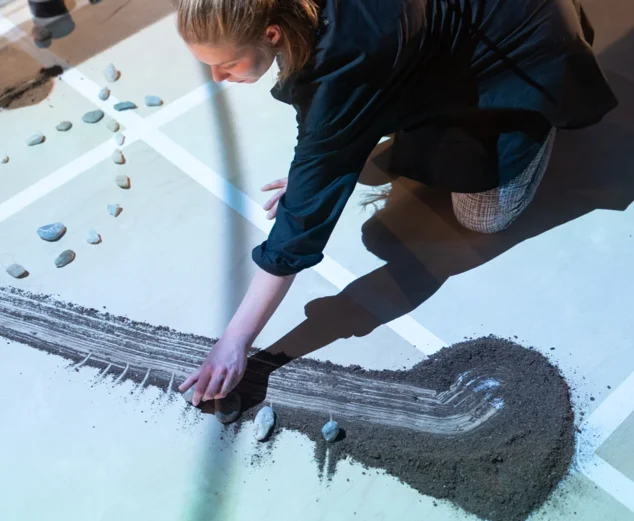
If a stone remains steadfast in its unchanging nature, what does that reveal about our own internal transformations?
For some time now, partly due to my own struggles with bulimia, I have been intrigued by how society frequently moulds individuals who harbour self-loathing to accept that they are their own fiercest rival, their own most hated enemy. Among young people—and I believe this applies to older individuals as well—there exists a significant prevalence of self-harm, addiction, and similar issues. In our exploration, stones represent the radically different—those aspects that appear incomprehensible, uncontrollable, unacceptable, unknown, and unpopular, both within ourselves and in the broader society.
It is an aspect of the world that we must first acknowledge, then approach, and ultimately embrace and nurture. In the interim, we must process the emotions and thoughts that emerge and manifest new ideas. An individual who harbours self-loathing finds it hard to tolerate themselves, much less others. As I have previously stated, our intention is not to physically assault, shatter, or reshape stones. Through our engagement with them, we aspire to achieve a level of understanding that surpasses the currently dominant ideas within our society.
The renowned Slovenian sculptor Jiři Bezlaj, who works with stone, has already enlightened us about the permanence or changeability of both stone and man. He describes a journey during which, at a certain moment, he aspired to surpass the devil, who possesses the strength to crush a stone in his hand, and to outdo Krojaček Hlaček, who can extract water from a stone—thus, he believed it would be amusing to tie stone into a knot. And that is precisely what he did. Nevertheless, he subsequently came to the realization that it is not within the inherent nature of stone to be fashioned into sweaters, prompting him to apologize to it in his subsequent series by placing ordinary, unrefined stones upon pedestals sculpted from semi-precious stones.
In what manner do your personal experiences shape your perception of stone as a representation of the radically other?
I regard stone as a representation of the radically other in thought.
“What propels us or transforms us in life invariably originates from what is concealed and has resided within the body for an extended period,” wrote the Anglo-Irish poet David Whyte in one of his verses. Stone compels me to fulfil my intentions. To accept accountability for my aspirations and for the present state of affairs. Responsibility is currently not a particularly popular concept in society, especially within the realm of politics.
When considering the body—it continues to be viewed as something separate, as an object, as a confinement, as a shell, as a mechanism. Subservient, let it work for us! Yet the body is vital to our existence on this planet and remains a significant mystery. As we delve into the constantly evolving nature of the body, we engage with something that is partially understood and partially enigmatic. As humans, we tend to prefer residing in the mind, where things can be neatly labelled, and controlled, understood and we remain unperturbed by surprises.
I chose to become a dancer specifically to gain a new perspective on my body, one that contrasts with how it was “presented” to me during the first two decades of my life. In contemporary dance, the various parts of the body are not organized hierarchically; they hold equal functional and imaginative significance. When lifting a fellow dancer, the priority is safety rather than which body parts are in contact
Engaging with dance partners allows for a variety of physical interactions far more dynamic and engaging than the routines of daily life: sitting, lying down, running, walking, or basic sexual positions. These interactions naturally elicit a range of emotional and psychological responses which must be addressed, maintained, and endured. Emotions serve as a guiding compass, and desire is intricately connected to responsibility, just as responsibility is intertwined with the potential for error. Of course, it is not my business to dictate how people live their lives. And I do not always possess such definitive answers for myself as those written down here and now on this paper appear to be.
In what ways do stone bridges differ from the bridges we construct between one another?
A well-constructed stone bridge endures indefinitely, much like a profound and genuine human relationship. Both require strength and effort, yet they are also defined by perseverance and elegance. Overall, I believe this inquiry is pertinent to contemporary society, as relationships are increasingly scarce—not only among children, due to smartphones and social media, but also among adults. There is considerable discourse about victims and the accountability of others, yet significantly less about taking responsibility. Allow me to present a seemingly trivial example: new neighbours cannot stand the noise coming from the floor above. It is just an ordinary family making ordinary noise. Nothing remarkable. They send text messages and emails, express dissatisfaction about them walking in high heels, despite the fact that no one in the family actually wears high heels. Yet they lack the courage to ascend one floor, ring the doorbell, confront the troublemaker directly, articulate their thoughts, and request that they quiet down. Why? Because relationships are tangible, and eyes are profound and demand significantly more from an individual than merely communicating their unhappiness through a text message, pretending they have not engaged in a relationship.
Stones are so ancient that they exist solely in infinity, which is to say, in the present moment, as Pogačnik notes. Being present in the moment is an intense experience. He further asserts that stones hold the key to the bridge that allows us to escape the chaos in which we find ourselves. Pogačnik associates stones with the philosphere, the realm of love. Just as Michelangelo perceived an angel imprisoned within stone and endeavoured to liberate it, we too shall attempt to partially release this angel within every audience member through the medium of stone.
I want to clarify that I am talking about the status of the victims in the West, not about the gruesome number of genocide victims in Gaza.
In fact, stone is more suited to conveying ideas than to being hammered—unlike humans,
who struggle both with conveying ideas and withstanding the force of a hammer.
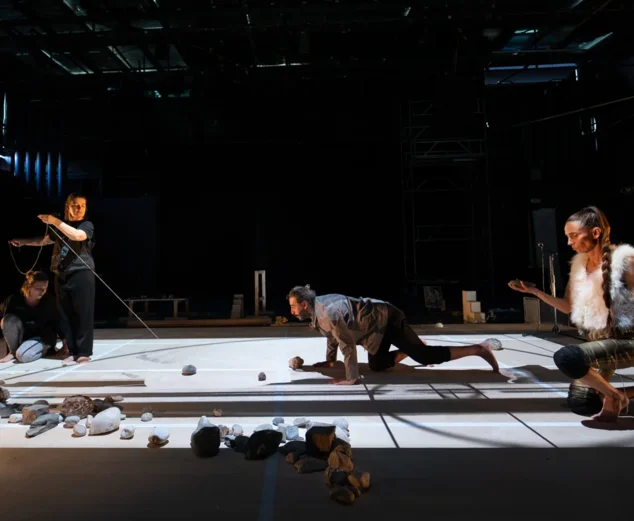
If stone represents something eternal, how is our fleeting existence recorded within it?
I do not know. In the future, they will be able to tell us. Bezlaj observes that stones profoundly absorb the energy of the artist. At the outset of the process at LGL, he suggested to us that stones are very grateful when treated with care. Perhaps it is through mercy and gentleness that we can etch our essence into stone, should we deem such inscription meaningful or necessary.
Ljubljana, October 2025
|
Published by Lutkovno gledališče Ljubljana Represented by Uroš Korenčan, general manager Artistic director: Mare Bulc Season: 2025/2026 |
Prepared by Benjamin Zajc Photos: Gregor Gobec, Petra Veber (photo of L. Jurišić) |
LUTKOVNO GLEDALIŠČE LJUBLJANA
KREKOV TRG 2, 1000 LJUBLJANA, SLOVENIA
T 00386 (0)1 300 09 82 / 00 386 (0)80 20 04
E BLAGAJNA@LGL.SI
WWW.LGL.SI
ONLINE TICKET SALES
Sponsors of the theatre
 |
 |